
Gain Therapeutics: rexaceract holds motor scores stable at 12 months

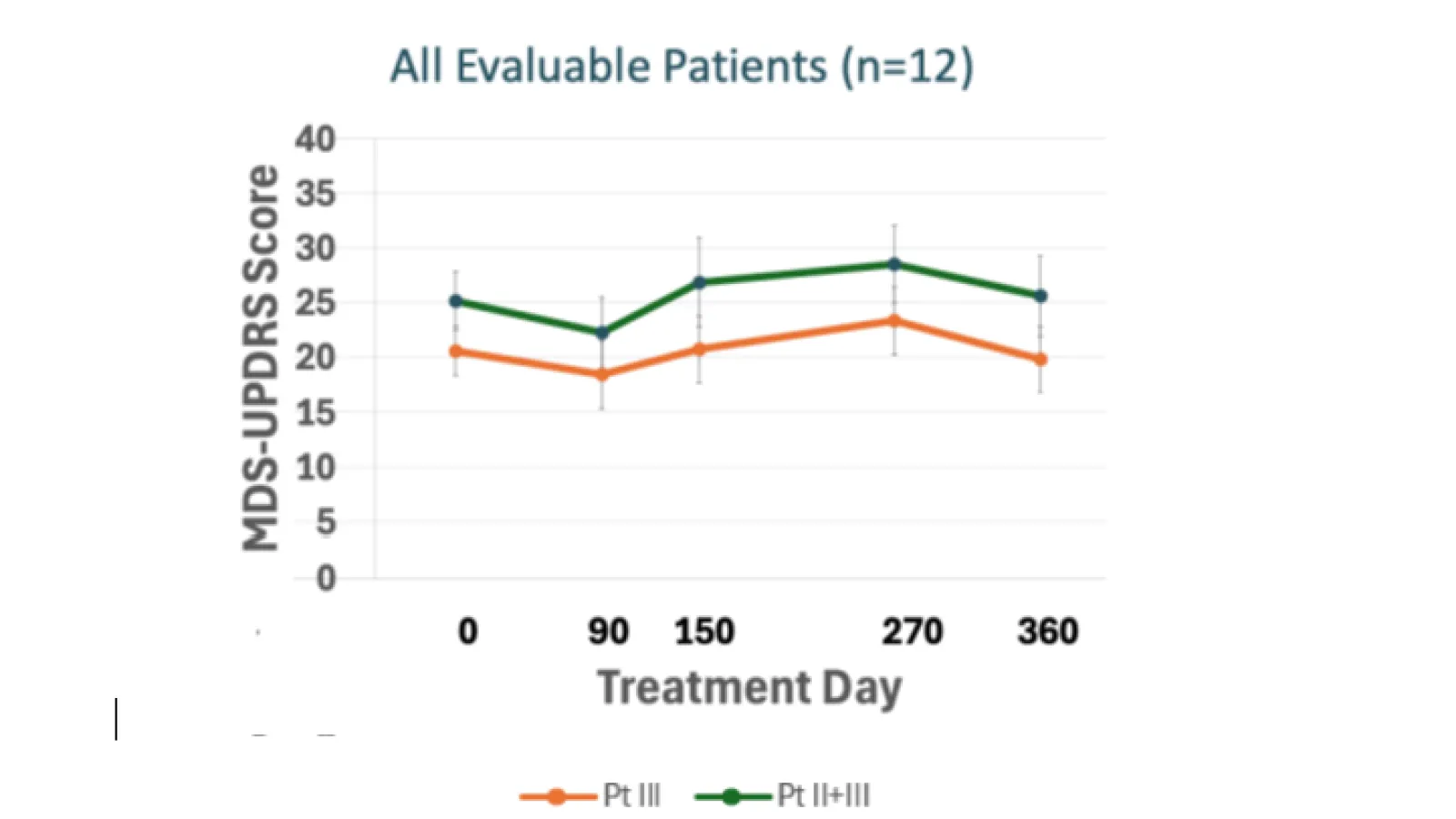
Gain Therapeutics has presented 12-month open-label extension data from its Phase 1b trial of rexaceract in Parkinson's disease, reporting that MDS-UPDRS motor scores remained stable to baseline across all 12 evaluable participants who completed dosing by 31 August 2026. The Nasdaq-listed company presented the findings as a poster at the International Congress of Parkinson's Disease and Movement Disorders in Seoul on 4 October 2026.
The MDS-UPDRS Parts II and III combined score is a widely used clinical benchmark for motor function. A change of approximately six points over 12 months is the generally accepted threshold for clinically meaningful progression in early Parkinson's disease; none of the 12 evaluable participants crossed that threshold over the course of the study. One further participant was still on treatment and scheduled to complete dosing in November 2026.
Biomarker stratification
A secondary finding of note is that stabilisation of motor scores was observed regardless of baseline cerebrospinal fluid levels of glucosylsphingosine (GluSph), a substrate of the enzyme glucocerebrosidase (GCase). Participants with high baseline GluSph experienced a rapid reduction in CSF levels within 90 days of treatment, consistent with increased GCase activity in the brain, yet both high and low GluSph groups showed comparable motor score stability at 12 months. The consistency across biomarker subgroups is relevant because it suggests rexaceract's clinical effect may not be confined to the GBA1-mutation subset of Parkinson's patients, potentially broadening the addressable population in a Phase 2 design.
Gene Mack, president and chief executive of Gain Therapeutics, said: "Seeing MDS-UPDRS scores remain stable after a full year of dosing is an important clinical milestone for rexaceract. This data gives us greater confidence in the durability of the clinical profile we are seeing and strengthens our conviction as we advance rexaceract into the next stage of development."
On safety, the company reported no new signals over the 12-month period. The incidence of treatment-emergent adverse events was lower in the nine-month extension phase than in the initial three-month dosing period, which the company described as indicative of a favourable long-term tolerability profile.
Phase 2 planning
Gain said it intends to submit a revised Phase 2 protocol to the US Food and Drug Administration within weeks, with a Phase 2 trial start now targeted for the first quarter of 2027. The protocol revision reflects insights from the Phase 1b as well as discussions with potential partners, pushing the original timeline back modestly to incorporate what the company characterised as a prudent design update.
The GCase-modulation space in Parkinson's disease has attracted sustained academic and industry interest since the genetic link between GBA1 mutations and PD was established. Several companies are pursuing GCase-targeted approaches, including small-molecule chaperones and enzyme-replacement strategies, though the field has yet to produce an approved disease-modifying therapy. Rexaceract's orally administered, brain-penetrant profile distinguishes it from enzyme-replacement approaches, and the allosteric mechanism differs from classical pharmacological chaperones, a distinction that may matter for regulatory and commercial positioning as the landscape matures.
Gain's Parkinson's programme has previously received funding support from the Michael J. Fox Foundation for Parkinson's Research, the Silverstein Foundation for Parkinson's with GBA, and European Union Horizon 2020 co-funding through the Eurostars-2 programme. The company also lists rexaceract as a candidate in Gaucher's disease, dementia with Lewy bodies, and Alzheimer's disease, though those indications remain at an earlier stage.