
Digbi Health expands precision biology telehealth to all 50 states

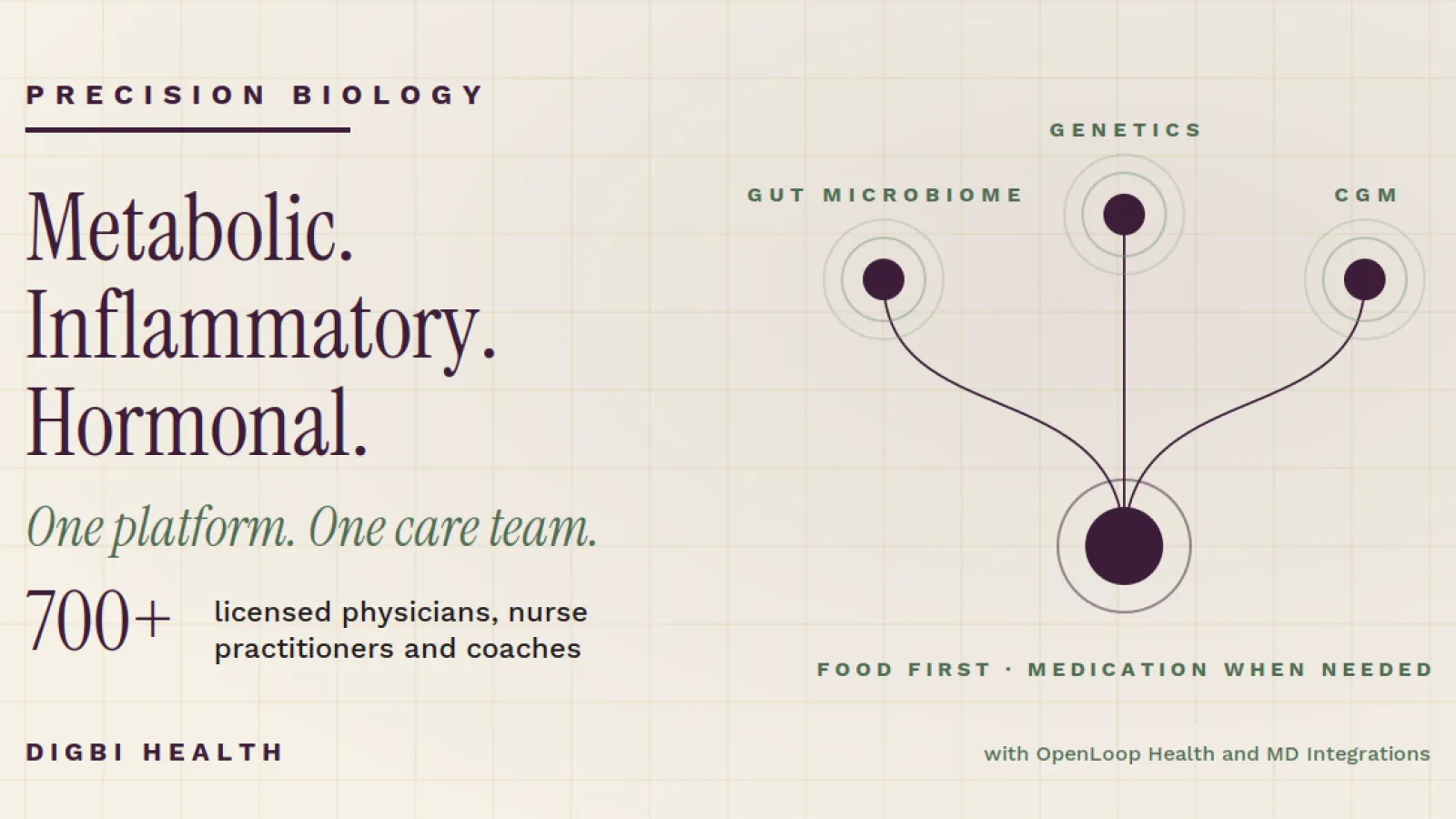
Digbi Health has extended its personalised metabolic and inflammatory care platform to all 50 US states through new clinical infrastructure partnerships with OpenLoop Health and MD Integrations (MDI). The arrangements give members of more than 300 employers and health plans access to over 700 physicians, nurse practitioners and health coaches, and enable prescribing of GLP-1 medications and hormone replacement therapy within the same integrated care plan.
The Mountain View-based company says its AI platform ingests genetics, gut microbiome sequencing, continuous glucose data, blood biomarkers and lifestyle information to personalise dietary and clinical recommendations. The model is described internally as "food-first, medication when needed", meaning pharmacological interventions are layered in only when a clinician judges them necessary, without requiring a separate referral pathway or a new application.
The partnerships
OpenLoop provides white-label clinician staffing and credentialing across multiple states, while MDI contributes a physician-only network of board-certified MDs and DOs covering all 50 states, the District of Columbia, Puerto Rico and Guam. MDI also handles pharmacy and diagnostic workflows, keeping clinical standards consistent as Digbi scales its patient volume.
Ranjan Sinha, founder and chief executive of Digbi Health, framed the expansion as a shift from niche offering to mainstream access. "For too long, it has been a luxury for those who could afford it," he said. "Our clinical infrastructure now matches our vision and science."
A peer-reviewed actuarial claims analysis published in the journal Healthcare, covering seven US self-insured employers, reported a reduction of $3,012 in overall medical spend per member per year. The company said its cost-reduction evidence is documented across multiple such peer-reviewed studies, though the release does not provide cumulative enrolment or outcomes data beyond that single figure.
Market context
Digbi is entering a crowded but rapidly expanding corner of digital health. The GLP-1 prescribing market has attracted a wave of telehealth platforms, including well-capitalised direct-to-consumer operators and employer-benefit intermediaries, all competing to wrap injectable weight-management drugs inside broader lifestyle programmes. Differentiation increasingly rests on clinical rigour, compliance infrastructure and the depth of personalisation offered, areas where omics-informed platforms such as Digbi are positioning themselves against simpler prescription-forwarding models.
Regulatory scrutiny of telehealth GLP-1 prescribing has intensified since the US Drug Enforcement Administration began reviewing pandemic-era flexibilities that allowed controlled-substance prescribing without an in-person visit. The FDA's compounding crackdown on semaglutide has also reshaped supply chains for some telehealth operators, making compliant physician networks and pharmacy workflows a genuine competitive variable rather than a commodity. Digbi's emphasis on MDI's compliance infrastructure and physician-only prescribing appears designed, in part, to pre-empt those concerns.
The company says it is accessible to 30 million individuals through its employer and health-plan network, though it did not disclose active enrolment figures or revenue in the announcement. Near-term milestones to watch include further peer-reviewed evidence from Digbi Labs, its research arm, and any movement toward additional health-plan contracting that would expand reimbursed access beyond self-insured employers.