
BPGbio reports 19.9-month median OS in MGMT-unmethylated GBM trial

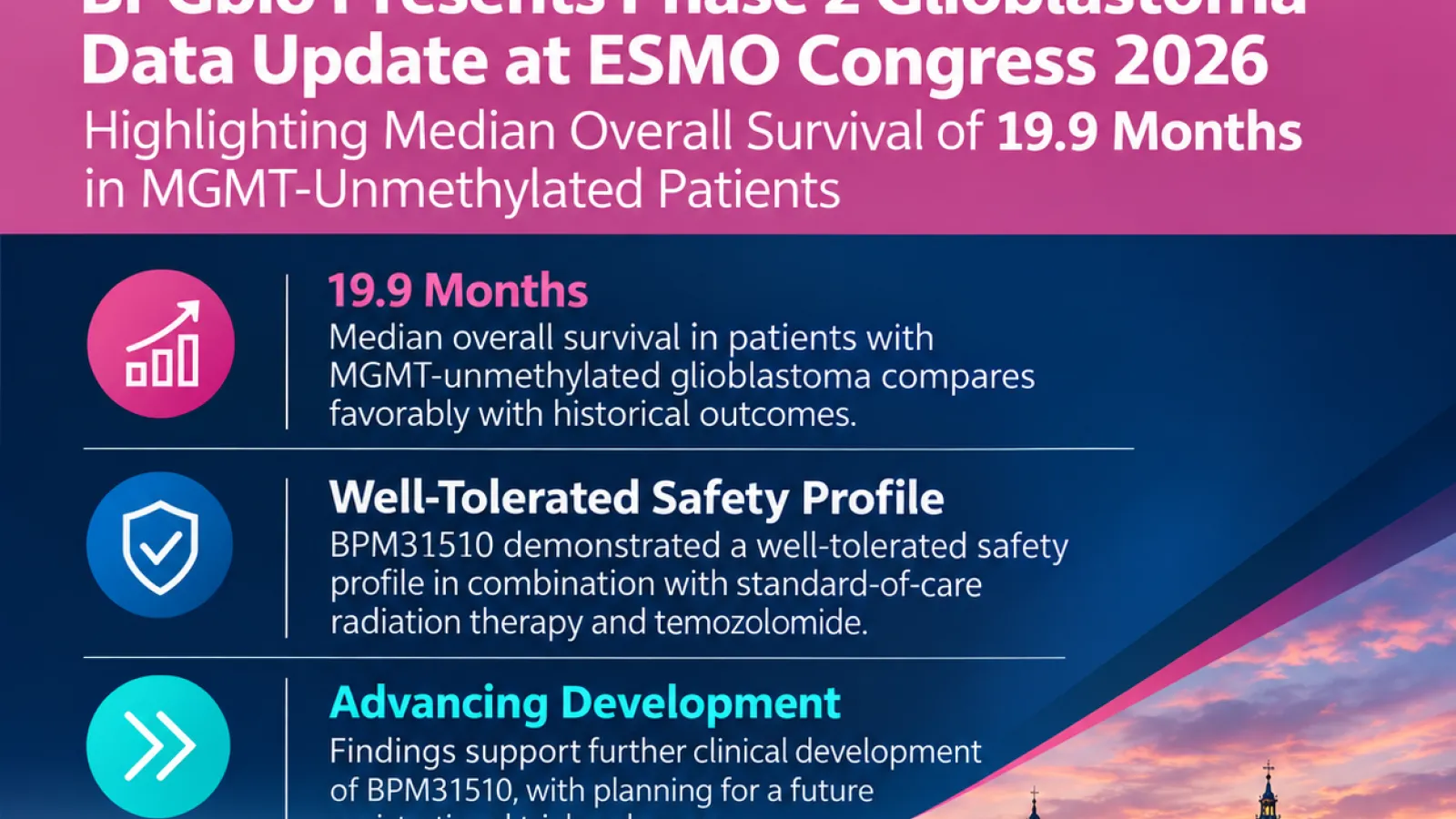
BPGbio has presented updated Phase 2 data for its mitochondrial modulator BPM31510 at the European Society for Medical Oncology Congress in Madrid, reporting a median overall survival of 19.9 months in MGMT-unmethylated newly diagnosed glioblastoma patients, a subgroup historically associated with median survival of between 12.7 and 15.5 months on standard-of-care treatment alone.
Across the broader per-protocol population of 44 patients, median overall survival reached 19.6 months. Tumour response at 12 months was more pronounced in the MGMT-unmethylated cohort of 28 patients, where the overall response rate was 17.9% and disease control rate 60.7%, compared with 11.4% and 50.0% respectively in the full population. BPM31510 was administered as a lipid nano-dispersion of oxidised CoQ10 with vitamin K1, given alongside standard radiation therapy and temozolomide.
Safety profile and mechanism
Investigators reported that BPM31510 did not appear to worsen the toxicity profile of the standard regimen, a finding the company describes as consistent with the candidate's design rationale. BPM31510 is intended to target altered mitochondrial metabolism in tumour cells, specifically to reactivate oxidative phosphorylation and modulate reactive oxygen species production in a way that restores apoptotic signalling. The hypothesis is that cancer cells' dependence on dysfunctional mitochondrial metabolism represents a vulnerability that can be exploited without disrupting normal tissue function.
Seema Nagpal, Clinical Professor of Neurology at Stanford University School of Medicine, said in the company's announcement that "what makes BPM31510 interesting is its approach to targeting altered tumour metabolism", and described the data as "an important foundation for further clinical investigation."
Niven R. Narain, President and CEO of BPGbio, said the survival signal in MGMT-unmethylated patients "reinforces our belief in the potential of mitochondrial metabolic modulation as a new therapeutic approach in oncology."
Registrational trial on the horizon
The Phase 2 study, NCT04752813, has completed enrolment with 51 patients across leading US cancer centres. BPGbio expects topline data from the final analysis in early 2027 and is planning a registrational trial, though no timeline, design, or regulatory agency engagement has been announced.
Glioblastoma multiforme remains one of the most difficult cancers to treat, with median survival following standard-of-care chemoradiation rarely exceeding 15 months in unselected populations and considerably worse in MGMT-unmethylated patients, who do not benefit from temozolomide-induced methylation of the MGMT repair gene. The absence of reliably effective second-line options has kept the field open to novel mechanisms, and a number of companies are pursuing approaches targeting tumour metabolism, immune checkpoint biology, and tumour-treating fields.
The MGMT methylation status distinction is clinically important and increasingly used as a stratification tool in trial design. Regulators, including the FDA and EMA, have generally required methylation-stratified analyses in GBM approvals and accelerated-approval discussions, which makes BPGbio's MGMT-unmethylated dataset particularly relevant for any future filing strategy. The company will need to demonstrate durability of the survival benefit in the final analysis, and a registrational design that satisfies a primary endpoint, most likely overall survival, before any approval pathway becomes realistic.