
Is health the next currency? What banking can teach healthcare
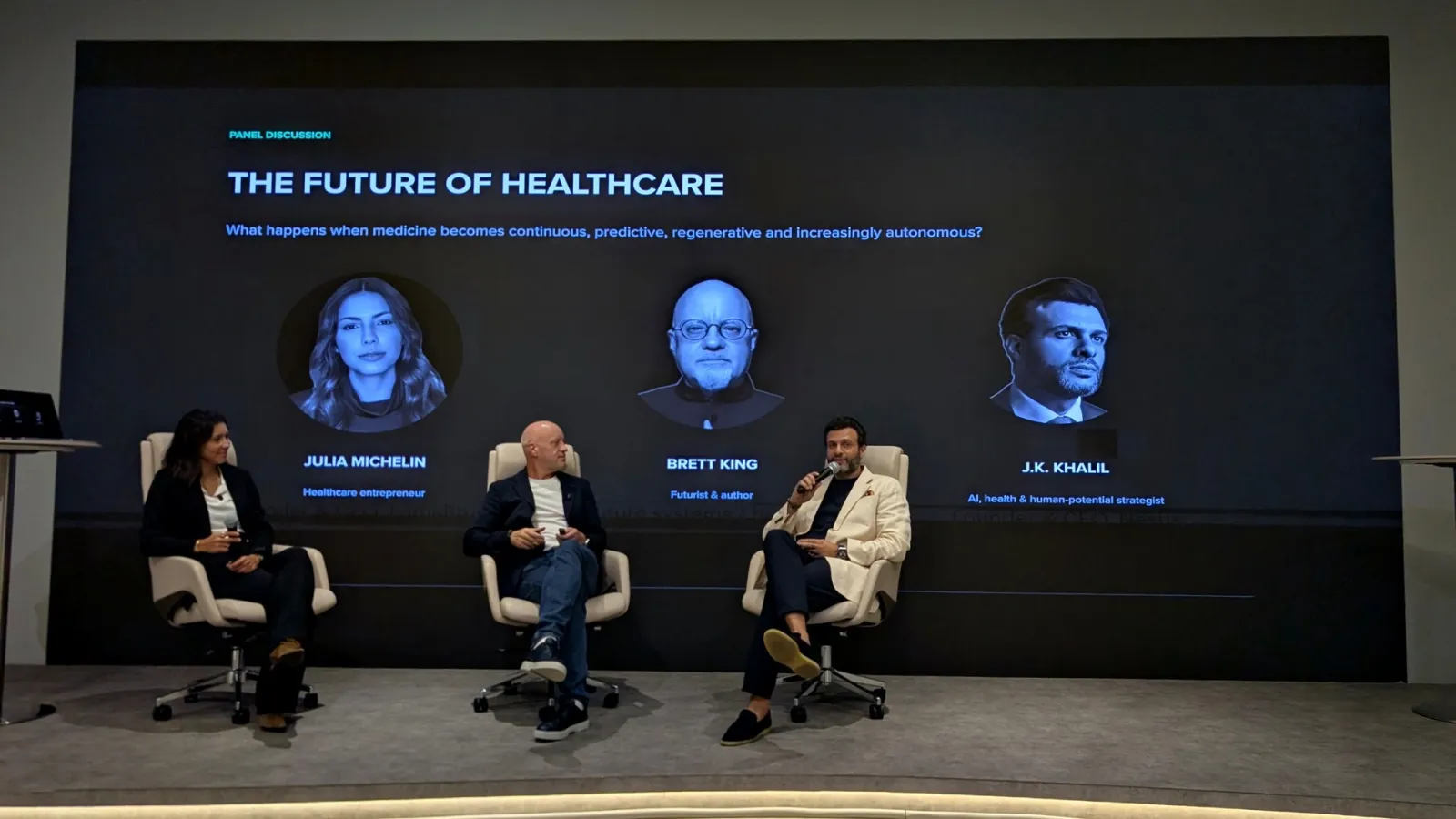
I started my working life in biotech. At Pro-curo Software we wrote a product that helps universities, hospitals and other research institutions manage and audit the human tissue they use in scientific research. Fintech came later. So an evening that promised to join the two halves of my career was always going to get me through the door. The fifth edition of the AI in Healthcare Unconference, hosted by TheBlock. and LumaBrush at One Central in Dubai on Wednesday, doubled as the regional launch of Bank 5.0: The Rise of the Agentic Bank, the new book from futurist Brett King, a week after its debut at the Singapore Fintech Festival.
A banking book is an odd guest of honour at a healthcare meetup. The link is a chapter contributed by Dr Julia Michelin, the dentist turned founder of LumaBrush, which opens with a simple question: is health an emerging currency?
Saving for a retirement we may be too ill to enjoy
The argument, as King and Michelin set it out, starts with something most of us will recognise. From the day we leave school we are told to save for retirement. Nobody tells us to do the same with our health. We spend 40 years building wealth, then spend a large part of it in our final decade paying for the damage.
King's view is that this bargain is about to look very dated. With gene therapy, regenerative medicine and AI-designed drugs arriving together, he expects life expectancy to move further in the next two decades than it did in the previous three centuries. Whether or not you accept his more ambitious numbers, the direction is hard to argue with, and populations are ageing either way. The World Health Organization expects more than a fifth of the world to be over 60 by 2050.
"When you talk about your wealth and you talk about health, you're talking about two sides of the same coin." Brett King
Checking your balance once every five years
The part of the evening that stayed with me was a comparison Michelin made. Imagine a bank that only let you check your balance once every five years, and never warned you about a suspicious transaction. Nobody would accept it. Yet that is roughly how most of us run our health: we find out something is wrong when it has become chronic and a doctor delivers the bad news.
Banking got from barter to coins to ledgers by finding a common way to measure value. The panel's case is that health is now going through the same step. Wearables such as Whoop and the Oura Ring already put a number on sleep, recovery and biological age. Add cheaper imaging, genomics and continuous monitoring and you arrive at what the book calls a health digital twin, a running balance for the body that flags the equivalent of a fraudulent payment years before symptoms appear.
King pointed to Midjourney, better known for AI images, which is building a full-body ultrasound scanner that lowers you into warm water and maps you in 3D. It is worth adding a note of caution here: the device's current US regulatory classification covers body composition, and diagnostic use would still need clearance from the FDA. The ambition is real, the medicine is not there yet.
The neobanks of healthcare
If the analogy holds, the next question is who builds it. Michelin was blunt. The first bank to let you order a card from your phone was not an incumbent, and she does not expect the incumbents of healthcare to behave any differently.
"The real change in healthcare, personally, I don't believe it's coming from the traditional hospitals or the traditional players. I believe it's coming from new companies, new technology-driven companies." Dr Julia Michelin
The money agrees with her. This month Oura agreed to buy AI primary care company Counsel Health for $625million, Whoop has raised $575million this year, and Isomorphic Labs, the Alphabet drug discovery company led by Sir Demis Hassabis, has just closed a $5billion round. Companies that began as a ring or a wrist strap are now signing partnerships with insurers and hospitals. That is the neobank playbook, applied to the body.
Her own route into this is telling. As a practising dentist she spent years carrying out root canals, and it was seeing young children arrive for that procedure that made her ask whether the profession was focused on the wrong end of the problem. Financial services talks constantly about financial literacy. Health literacy, as King put it, is the same gap by another name.
Health as a utility
J.K. Khalil, founder of Abu Dhabi venture builder Nexus Ventures and a contributing author to the book, took the idea furthest. His section of Bank 5.0 is about what he calls intent to outcome: you state what you want, and AI agents handle the products, paperwork and negotiation in between. Today, he argued, every customer is forced to be their own personal banker. In health we are forced to be our own care coordinator, repeating our medical history to each new doctor.
"Think about health becoming almost like a utility. You don't think about your health anymore, because you're always healthy." J.K. Khalil
His comparison was electricity. We do not think about it, we just expect the socket to work. In his version of the future an AI agent watches your data in the background, adjusts your supplements, and asks for your consent before it changes anything, setting out the trade-off in plain terms.
Move fast and break things?
This is where I put my hand up. I have watched the neobanks grow up, and their early motto was borrowed from Silicon Valley: move fast and break things. That may be tolerable when the worst outcome is a customer losing some money. It is not tolerable when the worst outcome is a patient. So I asked the panel who is responsible for protecting people when commercial companies take over more of our healthcare.
The answers were honest. Khalil said that in both industries the answer has been, thankfully, the regulator, and that builders should be talking to regulators early instead of building in a vacuum and hoping. King's view was that regulation itself will have to become infrastructure. Michelin went a step further and argued that regulators will need to use AI themselves, because nothing else will keep pace with the technology they are supervising.
I think that is right, and I also think it is the hardest part of the whole thesis. Finance took centuries, and several crises, to build the supervision it has now. Healthcare does not have that luxury if the timelines discussed on stage are even half correct.
Patients in founder mode
The best contribution of the night came from the floor. A doctor and health AI founder visiting from Silicon Valley described a new kind of patient: people who treat a serious diagnosis the way they would treat a start-up, sequencing their own genome and working directly with researchers on a personalised treatment. His question was how you give that kind of agency to everybody else, and not only to those with the money and the contacts.
Nobody on stage had a complete answer, and I am not sure there is one yet. But it is the right question. If health really is becoming a currency, then the risk is the one we already know from money: some people will be rich in it and many will not. The promise of the technology on show in Dubai this week is that the cost of knowing your own body falls far enough for that gap to close. Whether it does will depend less on the sensors and the models than on the rules we write around them.